
NCK Days 2026
Wednesday, 25 March 09:00 - Friday, 27 March 17:00
1931 VL, Netherlands
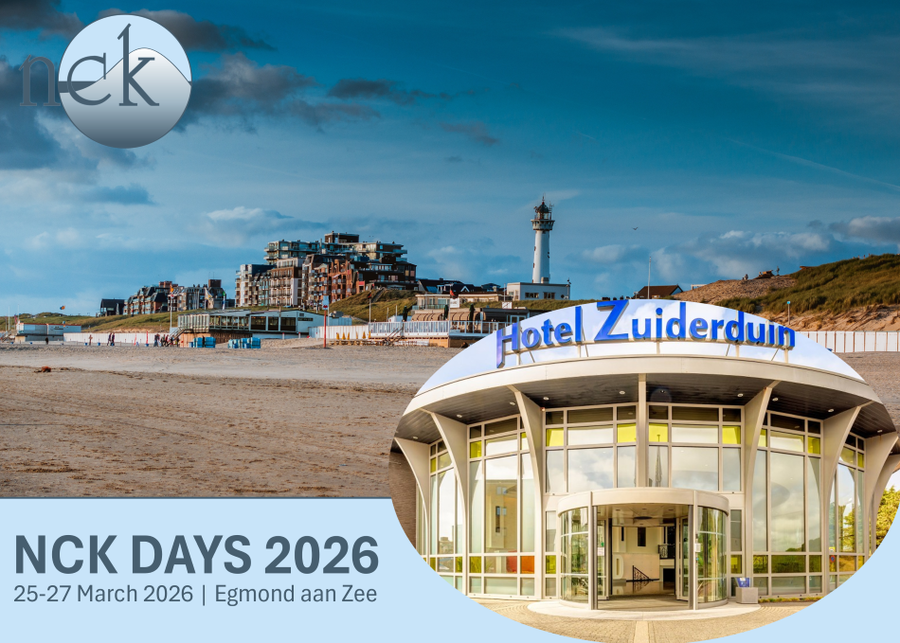
The NCK Days 2026 will take place from 25-27 March 2026 at Hotel Zuiderduin in Egmond aan Zee. The event will bring together young and leading researchers and professionals in coastal engineering and management for an inspiring and insightful gathering.
Registration & Call for abstracts
Join us at NCK Days 2026 to share your work, exchange ideas, and contribute to the ongoing dialogue on building resilient coasts in the face of climate change. Registration is open until March 2, 2026 — don’t miss your chance to be part of this inspiring event!
Call for Abstracts: We invite you to submit your abstracts for oral and poster presentations at NCK Days 2026. Share your latest research, innovative solutions, and best practices with the NCK community. Contributions are welcome on all aspects of the coastal system, including fieldwork, numerical modeling, conceptual studies, and laboratory experiments. The deadline for abstract submission is extended to 24 February 2026. Visit our Book of Abstracts website for submission guidelines and further information.
Program
Wednesday March 25
The event will kick off on Wednesday, 25 March, with an afternoon excursion to the Hondsbossche Duinen, located between Petten and Camperduin. This area was once the Hondsbossche and Pettemer Sea Defence (HPZ), a hard sea dike that protected the coast. Between 2013 and 2015, the dike was transformed into a nature-based solution: the Hondsbossche Duinen (HBD). Through large-scale sand nourishment, a wide beach and dynamic dune landscape replaced the traditional dike, creating a more natural coastal defense. Now, more than 10 years later, we return to this site to explore what we can learn from its development — the successes achieved, the challenges faced, and the lessons for future projects.
In the evening of Wednesday, 25 March, we will gather at the conference venue for the Icebreaker. Join us for informal drinks to kick off two inspiring days of discussions and networking. To make the evening even more engaging, Young-NCK has prepared a short activity designed to truly break the ice and help participants connect in a fun and relaxed way.
Thursday March 26 & Friday March 27
Over the following two days, we will host a series of engaging oral and poster sessions. Each day will start with a keynote lecture. On Thursday, the keynote will be delivered by Gerben Ruessink (Professor at Utrecht University), who will discuss the role of Egmond as one of the Dutch beach measurement–model hotspots, covering the system from deep water all the way into the dunes. On Friday, Fedor Baart (advisor at Rijkswaterstaat) will give the keynote, focusing on how art can be used in coastal reconstructions.
For the sport enthusiasts, the Friday morning of the conference (27th of March) will begin with a refreshing morning run organized by Y‑NCK. We will meet outside Hotel Zuiderduin at 7:15 AM, so don’t forget to pack your running shoes and join us for an energizing start to the day.
The draft programme is available below, note that it is subject to change. A URL to the abstracts will follow soon.
[draft] Programme
| Wednesday 25 March 2026 | ||
| 12:30 - 17:00 | Excursion Hondsbossche Dunes (more information soon) | |
| 12:30 | Departure by touring car from Hotel Zuiderduin | |
| 12:50 | Additional pick-up stop: Alkmaar Station (en route to Camperduin) | |
| 13:15 | Arrival at Camperduin (next to Strandpaviljoen STRUIN) | |
| 13:30 - 16:00 | Excursion | |
| 16:00 - 16:30 | Travel back to Hotel Zuiderduin by touring car | |
| 20:00 - 22:00 | Icebreaker at Hotel Zuiderduin (Egmond aan Zee) | |
| Thursday 26 March 2026 | ||
| 08:30 - 09:00 | Registration | |
| 09:00 - 09:10 | Opening ceremony | |
| 09:10 - 10:00 | Keynote Gerben Ruessink: 'Wrapping up our knowledge from deepwater to the dunes' | |
| 10:00 - 10:15 | Poster pitches | |
| 10:15 - 11:00 | Coffee break and poster session | |
| Basnayake Assessing global-scale coastal vulnerability and identifying the dominant contributors | ||
| Ton Fines and nutrients around the Marker Wadden | ||
| Van Rees Guano fertilization modifies dune-engineering traits consistently across species and origins | ||
| Löhr Long-term volumetric changes in response to repeated shoreface nourishments at Egmond-Bergen, the Netherlands | ||
| Portos-Amill How can we model the interactions between tidal sand waves and the underlying sand bank? | ||
| Galiforni-Silva Towards a cross-shore beach-dune model for hybrid dune-dike systems | ||
| Faraji Gargari A Coupled AeoLiS–OpenFOAM Model for Wind Flow and Bed Morphology Evolution in Coastal Dunes | ||
| Kroon A fast and accurate model for coastal management of Maasvlakte 2 | ||
| Stuurman A laboratory on the beach: Quantifying aeolian transport of nourished sediment using SfM in a mobile flume | ||
| Fan Analyzing the Relationship Between Hydrodynamics and Water Quality Influenced by Oyster Reefs | ||
| Wassink Are the tidal flats of the Wadden Sea drowning? | ||
| Van Veelen Co-creating a sand extraction toolbox for tidal sandbanks | ||
| Van Asselt Comparison and assessment of wavemaker theories for laboratory wave generation | ||
| Zwolanek CSHORE-Veg: Implementing Vegetation Drag Forces for Depth-Varying Plant Morphology | ||
| Hulskamp Dancing Dunes: how short-term patterns create long-term trends | ||
| Vallen Data analysis reveals a linear relation between peak discharge and cross-sectional area of the tidal divides in the Dutch Wadden Sea | ||
| De Vries Decadal Development of Coastal dunes on the Wadden Sea Islands affected by Interventions. | ||
| Dutta Delta-ENIGMA: advancing biogeomorphology research in deltas through observation and experimentation | ||
| Kampman Development and application of a novel portable windtunnel system for assessing the effect of vegetation on sediment transport | ||
| Bonenkamp Effect of Variability in River Discharge and Sediment Supply on Morphodynamic Timescales in Estuaries | ||
| Guo Experimental quantification of biomass effect on sand shear strength and its implementation in storm-driven dune evolution modelling | ||
| Huisman Experimental setup of a field study on shoreface nourishment behaviour at Ameland | ||
| Sonnemans Exploring Relations between Megaripple Geometry and a Subsea Pipeline in the North Sea | ||
| De Bruijn Field measurements and modelling to quantify shoreface nourishment impact | ||
| Van Rosmalen Follow the flow: Using vegetation, topography, and points of interest in landscape design allows for the co-existence of recreation and nature on the beach. | ||
| Loftus Growth Rates, Sediment, and Infauna in Stands of Introduced Mangroves (Rhizophora stylosa) in Moʻorea, French Polynesia | ||
| Mi Historical assessment of standing and progressive tidal waves, tidal asymmetries, and sediment transport in estuaries using a novel approach | ||
| Reyes Castillo Initial Results from Field Observations of Stratification and Velocity Structure in Two Bottom Depressions of the Haringvliet Estuary | ||
| Broekhorst Interaction of wind, waves and currents at a sheltered beach - the Prins Hendrikzanddijk | ||
| Brils The effects of reduced maintenance dredging in tidal channel Boontjes in the Dutch Wadden Sea: Field monitoring and available data | ||
| Tobal-Cupul Defining Storm Conditions Dominating Salt Marsh Accretion | ||
| Jorritsma Sandscaping Coastal Identities | ||
| Nauta Reading beach–dune systems: Linking physiotopes to community assembly | ||
| 11:00 - 12:00 | Session 1: Estuaries & Tidal Basins | |
| 11:00 - 11:12 | Bhoobun A numerical study of the interactions between intertidal mudflat morphodynamics and tidal creek development | |
| 11:12 - 11:24 | De Swart Cyclical trouble: how does the evolution of the Spijkerplaat impact the coverage of the Borssele export cables? | |
| 11:24 - 11:36 | Grandjean Dredging as slow-motion murder of estuaries | |
| 11:36 - 11:48 | Meijers How methodological choices shape the interpretation of morphological trends in the Wadden Sea: towards a uniform approach for surface area classification | |
| 11:48 - 12:00 | Bulens Nature-based solutions to elevate barrier islands (WAD was - WAD can we do?) | |
| 12:00 - 13:00 | Lunch and poster session (continued) | |
| 13:00 - 14:00 | Session 2: Nourishments | |
| 13:00 - 13:12 | Brand Nourishments: Learning in Practice | |
| 13:12 - 13:24 | Nnafie Effects of sea-level rise and sand nourishments on shelf–shoreline morphodynamics: observations and modelling | |
| 13:24 - 13:36 | Coumou Lowering the crest of a beach nourishment to reduce beach armouring – Results of a field campaign at Vlieland | |
| 13:36 - 13:48 | Brakenhoff An evaluation of the Ameland Ebb-Tidal Delta Nourishment | |
| 13:48 - 14:00 | Hoegen Artificial dune blowout evolution under extreme storm conditions and their effect on flood safety | |
| 14:00 - 14:30 | Coffee break | |
| 14:30 - 15:30 | Session 3: Salt Marsh & Mangroves | |
| 14:30 - 14:42 | Dzimballa Quantifying Salt Marsh Edge Dynamics Using UAV-Data: Hydrodynamic and Morphodynamic Controls in the Dutch Wadden Sea | |
| 14:42 - 14:54 | Paul Sediment Dynamics in Brushwood-Groyne Salt Marshes: A Wadden Sea Island Study | |
| 14:54 - 15:06 | Van Puijenbroek Vegetation diversity in Wadden Sea salt marshes: the role of scale, geomorphology and management | |
| 15:06 - 15:18 | Willemsen Salt marsh vegetation provides additional wave attenuation during extreme storm events at low-energy marsh coasts globally, despite progressive vegetation damage | |
| 15:18 - 15:30 | Broenink Mapping Hydrodynamic Drivers of Hypersalinity in Mangrove Ecosystems. | |
| 15:30 - 16:00 | Coffee break | |
| 16:00 - 17:00 | Session 4: Experiments | |
| 16:00 - 16:12 | Roelvink Observations and modelling of atoll island morphological response to sea-level rise | |
| 16:12 - 16:24 | Li Effects of tidal asymmetry on the morphodynamics of estuaries in physical scale experiments | |
| 16:24 - 16:36 | Smits The effects of reduced maintenance dredging in tidal channel Boontjes in the Dutch Wadden Sea: The analysis of extensive field monitoring | |
| 16:36 - 16:48 | Geleynse Initiation of motion of mixed mud-sand beds – findings from the MUSA II program | |
| 16:48 - 17:00 | Van Weerdenburg Effects of drying of intertidal mudflat beds on sediment erodibility and mudflat evolution | |
| 17:00 - 17:15 | Awards ceremony Thursday & closing | |
| 17:15 - 18:30 | Drinks | |
| 18:30 - 21:00 | Dinner & Young NCK activity | |
| Friday 21 March 2025 | ||
| 7:15 | Y-NCK morning run (optional) | |
| 08:30 - 09:00 | Registration | |
| 09:00 - 09:30 | Keynote Fedor Baart: 'The art of reconstruction' | |
| 09:30 - 10:30 | Session 5: Hydrodynamics & Sediment Transport | |
| 09:30 - 09:42 | Beemster Floods on a Schedule: Predictable Timing in Tidal Coastal Systems | |
| 09:42 - 09:54 | Van Oudenallen Modeling the influence of Earth’s rotation on wave-induced transport in the nearshore region | |
| 09:54 - 10:06 | Petridis Numerical investigation of cross-shore evolution of skewness and asymmetry of surface elevation and nearbed velocity | |
| 10:06 - 10:18 | Haakman Tidal Asymmetry as a Driver of Spatial Variability in Sea-Level Rise in the Ems Estuary | |
| 10:18 - 10:30 | Ploeg Sand Extraction on the Netherlands Continental Shelf: Idealised Modelling of Sand Waves, Extraction Pits and Cohesive Sediment | |
| 10:30 - 10:45 | Poster pitches | |
| 10:45 - 11:30 | Coffee break and poster session | |
| Hillen-Schiller Lines in the sand – using channel autodetection for sediment budgets of estuaries | ||
| Gijsman Mangrove-Vegetated Upper Intertidal Flat Response to Tides and Waves | ||
| Shah Modeling Shoreface Nourishment Morphodynamics along the Ameland Coast | ||
| Van Der Lugt Modelling Bedload on a Coarse-grained, Low-Energy Beach | ||
| Nannes Modelling salt marsh development in front of the gentle slope of a broad green dike: A case study for Schiermonnikoog | ||
| Chin Niche Differentiation Drives Divergent Roles of Root-Associated Prokaryotic and Eukaryotic Microbes in Community Structure and Interactions in Mangrove Forests | ||
| Steenman Operational forecast of salinity levels in the Haringvliet Outer Delta using Machine Learning | ||
| Van Der Hoorn Performance assessment of HurryWave in the North Sea using climate datasets | ||
| Meijer Preliminary results on the effects of salt marsh vegetation structure on hydrodynamics and drag at single plant scale in a CFD model | ||
| Attema Process-Based Morphodynamic Modelling of Tidal Flat Nourishment Evolution in the Eastern Scheldt | ||
| Overes Sand nourishment strategy development in the (inter)national context | ||
| Shafiei Spatio-temporal variability of sand sources is tied to morphodynamic states: a case study of an idealised rip–shoal system | ||
| Van Dijk The future of the Rhine-Meuse delta channel network and implications for the storm surge barriers | ||
| Leestemaker Unearthing Saltmarsh Adaptive Capacity to Sea Level Rise | ||
| Wang Unravelling the Mechanisms of Moisture-Modified Aeolian Sediment Transport: A Continuum Modelling Approach | ||
| Harms WAD was - WAD can we do? - Overview of the Transdisciplinary Structure and Methodologies of the WADWAD Project | ||
| Daugharty Acoustic Observations of Stratified Atlantic–Mediterranean Exchange and Tidal Structure | ||
| Van Der Lee Assessing intraspecific genetic variation from multi species DNA samples. | ||
| Kuin Evaluation of managed re-alignment strategies as nature-based solutions | ||
| Zorndt Investigating fine sediment disposal by numerical modeling and field measurements in the Jade, Germany | ||
| Van IJzendoorn Measuring vertical aeolian sand transport patterns to improve coastal dune models | ||
| Meruma Monitoring eutrophication in coastal areas | ||
| Koppenol Onderzoeksprogramma en het nieuwe project-MER Zand uit Zee | ||
| Berghuis Spatial self-organization in developing coastal dune systems | ||
| Hunter The evolution of tidal flat bed strength across consecutive inundations – A proposed investigation for conceptual understanding | ||
| Noshin The Influence of Cadmium (Cd) on Physiology, Anatomy, and Chemical Composition of Xylocarpus mekongensis Pierre Seedlings | ||
| Bond The Influence of Cobble Volume on Dynamic Cobble Berm Revetment Performance | ||
| Huismans Understanding infilling processes in de Wadden Sea with the ASMITA model | ||
| Brakkee Understanding the Role of Stratification in Phytoplankton Dynamics to Improve Monitoring Strategies in the Dutch North Sea: A Research Proposal | ||
| Wallinga Luminescence tracing of coastal sediments - insights from the TRAILS project | ||
| Sanders Valuing coastal ecosystem condition: Integrating visitor preferences and remote sensing in Curaçao | ||
| Van Oijen Field observations of cross-shore chenier dynamics and hydrodynamics in Demak, Indonesia | ||
| Daliri Impact of Sand Extraction on Thermal Stratification in Shelf Seas | ||
| 11:30 - 12:30 | Session 6: Waves & Storm Response | |
| 11:30 - 11:42 | Poppema Storm-driven erosion of hybrid dunes: insights from a field experiment | |
| 11:42 - 11:54 | Faizal Wave Friction On Various Coral Reef Covers In Small Tropical Islands | |
| 11:54 - 12:06 | De Wit Wave overtopping predictions and measurements for very long and low steepness swell waves | |
| 12:06 - 12:18 | Sevindik A numerical investigation of the effect of profile change on overtopping over time of a dune-dike hybrid structure | |
| 12:18 - 12:30 | Neshamar A representative wave for cross-shore sediment transport | |
| 12:30 - 13:30 | Lunch and poster session (continued) | |
| 13:30 - 14:30 | Session 7: Emerging techniques | |
| 13:30 - 13:42 | Leijnse Advances in hybrid surrogate modelling of coastal compound flooding: how actionable is machine learning? | |
| 13:42 - 13:54 | Macher Where urbanisation hits hardest: eDNA reveals habitat-dependent biodiversity change across a beach–dune ecotone | |
| 13:54 - 14:06 | Boersma CFD modeling of sediment placements in deep channels | |
| 14:06 - 14:18 | Vos Vegetation structure estimation using local point cloud geometry | |
| 14:18 - 14:30 | Roelvink An implicit scheme for ShorelineS? | |
| 14:30 - 14:45 | Awards ceremony Friday & Closing ceremony | |
Venue
The conference will take place at Hotel Zuiderduin in Egmond aan Zee, a charming coastal town on the North Sea. Both the Icebreaker on Wednesday evening and the Conference Dinner on Thursday will be hosted at this venue.
Accommodation
For the upcoming NCK Days, participants are responsible for arranging their own accommodation. You are free to choose from hotels, bungalow parks, or Airbnbs according to your preference. Please note that no special discount arrangements are available.
To foster a sense of community and make networking easier, we recommend booking your stay at Hotel Zuiderduin, where the conference sessions, Icebreaker, and Conference Dinner will also take place.
Organisation
The NCK Days 2026 are organised by Deltares: Bas Huisman, Bas van Maren & Nienke Vermeer-Schiettekatte. If your have any questions, please contact the organisation via
